

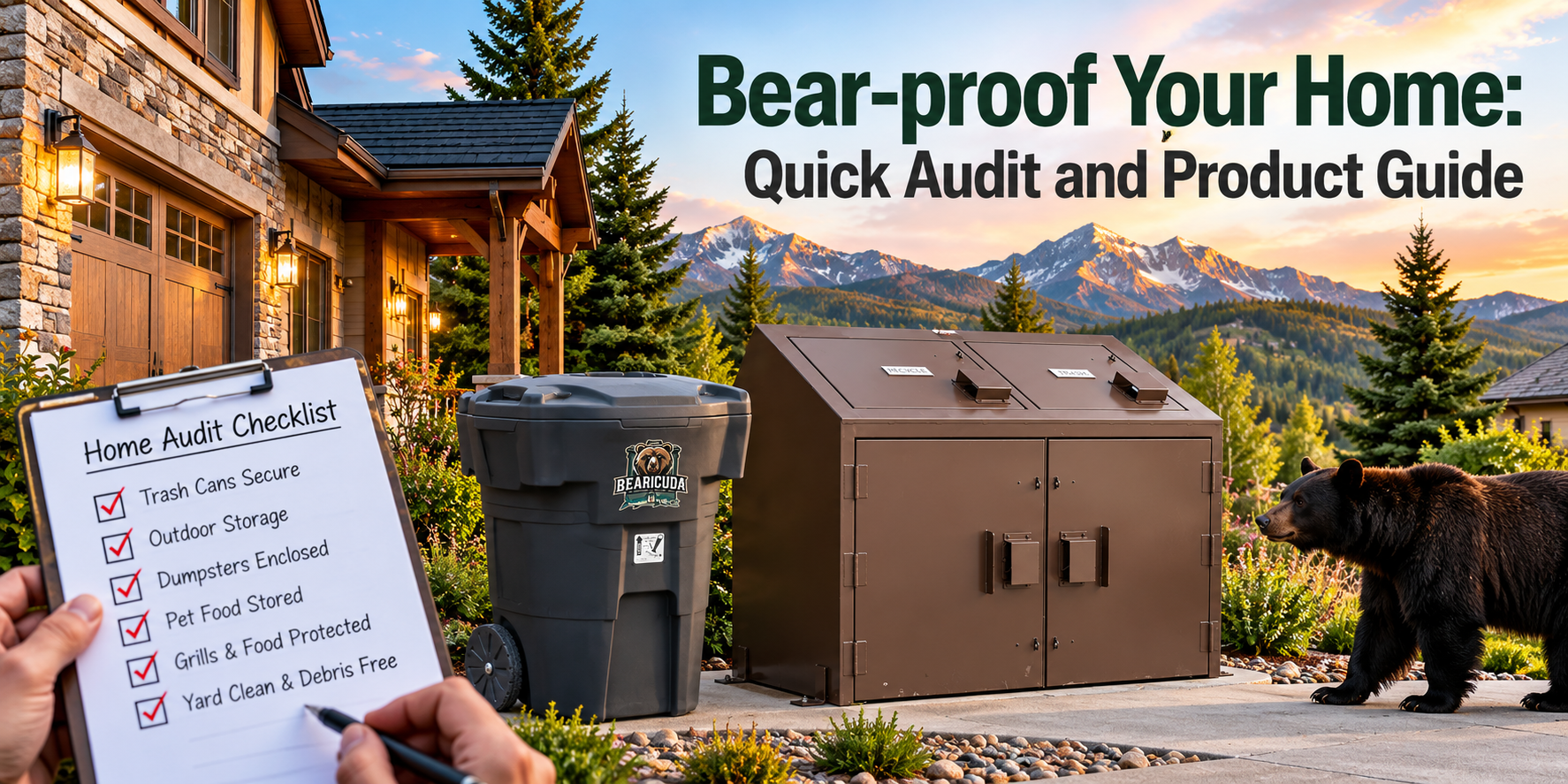
Bear-Proof Your Home: Quick Audit & Product Guide
Bears learn quickly when homes offer easy food. The highest-impact steps are securing garbage, removing bird food, and managing compost so it does not smell like a meal. Wildlife agencies recommend keeping garbage secured until pickup morning, taking down bird feeders in bear-active areas, and protecting compost with a bear-resistant enclosure or electric fence. myfwc - Florida Fish and Wildlife Conservation Commission
Top Bear-Attracting Mistakes
Leaving trash unsecured
Mistake: Putting standard carts at the curb overnight, leaving lids unlatched, or storing garbage outdoors without a protected container.
Fix: Keep garbage in a garage, shed, or bear-resistant cart/enclosure. Put it out on the morning of collection, not the night before, and keep the container closed and latched at all other times. myfwc
Keeping bird feeders up
Mistake: Treating bird seed as harmless. Seed, suet, nectar, and spilled feed can all attract bears.
Fix: The most reliable option is to remove bird feeders while bears are active. If a feeder remains, bring it in before dark, use only the amount birds can finish during the day, and promptly clean spilled seed. myfwc+1
Composting food scraps openly
Mistake: Adding meat, fish, bones, greasy foods, sweet scraps, or large quantities of fruit to an open compost pile.
Fix: Use a hard-sided, lidded compost system protected by a bear-resistant enclosure or electric fence. Avoid meat, bones, and seafood; reduce odors by maintaining a roughly three-to-one balance of dry “brown” material to food-rich “green” material and turning the pile regularly. dam.ohio
Forgetting secondary attractants
Mistake: Leaving pet food, grill grease, coolers, livestock feed, chicken feed, or fallen fruit outdoors.
Fix: Bring pet bowls indoors overnight, clean grills after every use, secure feed and coolers, and collect fallen fruit promptly. Agencies also recommend protecting gardens, beehives, compost, and livestock-related attractants with electric fencing where appropriate. myfwc
Residential Bear-Proofing Checklist 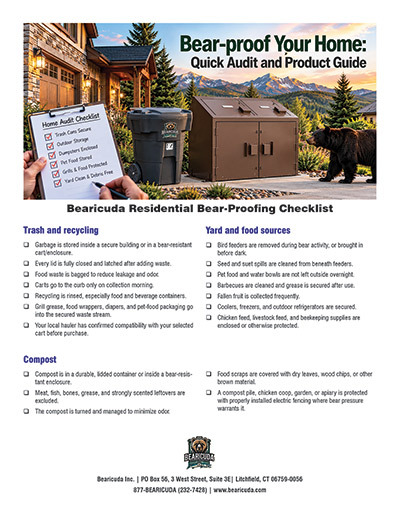
Trash and recycling
- Garbage is stored inside a secure building or in a bear-resistant cart/enclosure.
- Every lid is fully closed and latched after adding waste.
- Food waste is bagged to reduce leakage and odor.
- Carts go to the curb only on collection morning.
- Recycling is rinsed, especially food and beverage containers.
- Grill grease, food wrappers, diapers, and pet-food packaging go into the secured waste stream.
- Your local hauler has confirmed compatibility with your selected cart before purchase.
Yard and food sources
- Bird feeders are removed during bear activity, or brought in before dark.
- Seed and suet spills are cleaned from beneath feeders.
- Pet food and water bowls are not left outside overnight.
- Barbecues are cleaned and grease is secured after use.
- Fallen fruit is collected frequently.
- Coolers, freezers, and outdoor refrigerators are secured.
- Chicken feed, livestock feed, and beekeeping supplies are enclosed or otherwise protected.
Compost
- Compost is in a durable, lidded container or inside a bear-resistant enclosure.
- Meat, fish, bones, grease, and strongly scented leftovers are excluded.
- Food scraps are covered with dry leaves, wood chips, or other brown material.
- The compost is turned and managed to minimize odor.
-
A compost pile, chicken coop, garden, or apiary is protected with properly installed electric fencing where bear pressure warrants it. myfwc+2
Bearicuda Product Recommendations
Bearicuda offers two main approaches for residential curbside waste: an automated bear-resistant cart for households that need one self-contained container and steel enclosures for homeowners who need an added physical barrier around a cart.
| Product | Best for | Capacity | Curbside collection compatibility | Security approach |
|---|---|---|---|---|
| Stealth 65-Gallon Fully Automatic Bear-Resistant Can | Smaller households, lower weekly waste volume, or tighter storage footprints | 65 gallons | Designed to open during dumping by compatible fully automated hauler trucks; verify your local hauler’s equipment and requirements before ordering | Interlocking lid design with a locking/latching system intended to keep wildlife out while allowing automated emptying |
| Stealth 95-Gallon Fully Automatic Bear-Resistant Can | Larger households, families, or homes with more weekly trash | 95 gallons | Designed as a fully automated curbside refuse cart for compatible automated truck collection; confirm compatibility with your waste provider first | Rotationally molded body with an interlocking lid and bear-resistant locking arrangement |
| Metal 65-Gallon Roll-Away Bear-Proof Trash Enclosure Cart | Homes that already use a compatible cart and want a heavy-duty steel enclosure | Designed for a 65-gallon cart configuration | Enclosure/cart setup should be confirmed with the hauler based on curbside setout and service method | Steel enclosure intended to resist bears and smaller chewing animals, with a secure access door/lid arrangement |
| Metal 95-Gallon Roll-Away Bear-Proof Trash Enclosure Cart | High-volume households or properties needing maximum cart capacity inside a metal enclosure | Designed for a 95-gallon cart configuration | Confirm whether your hauler requires removal, opening, placement, or another procedure on collection day | Steel, animal-resistant barrier around the larger cart format; secure it fully after each use |
Choosing 65 vs. 95 gallons
Choose a 65-gallon Stealth if your household creates modest weekly trash volume, has limited storage space, or currently uses a smaller cart. Bearicuda lists exterior dimensions of approximately 26.31 inches wide by 34.13 inches deep by 42.50 inches high for this model. bearicuda
Choose a 95-gallon Stealth if your household routinely fills a standard large curbside cart, has multiple residents, produces bulky bagged waste, or wants more capacity between collection days. Bearicuda lists the 95-gallon model at approximately 30.13 inches wide by 36 inches deep by 45.25 inches high, with a listed weight of 56 pounds. bearicuda
Automated collection note
The key benefit of Bearicuda’s Stealth 65- and 95-gallon carts is their stated ability to work with fully automated curbside collection trucks: the cart is intended to open when the truck mechanically tips it for emptying, then return to a secured state. bearicuda
However, “automated compatible” does not mean universal compatibility. Before buying, verify all of the following with your solid-waste provider:
-
Accepted cart dimensions, lift-bar or grab-point configuration, and maximum cart weight.
-
Whether the hauler permits customer-owned carts.
-
Required curb placement, orientation, lid clearance, and spacing from other carts.
-
Whether the service provider requires its own branded cart.
-
Whether local ordinances require a specific bear-resistance certification or container type.
Best-Practice Setup
For most homes in bear country, the strongest approach is a layered system:
-
Use a properly latched Bearicuda Stealth cart sized to your household’s actual weekly waste.
-
Store the cart in a garage, shed, or additional metal enclosure when it is not awaiting pickup.
-
Set the cart out only on collection morning.
-
Remove bird feeders during bear season or whenever bears are active nearby.
-
Use enclosed, low-odor composting or suspend food-scrap composting until bear activity subsides.
-
Remove every other food reward, especially grill grease, pet food, fallen fruit, and animal feed.
A bear-resistant cart is an important barrier, but it works best as part of a property-wide attractant-management plan. Once a bear obtains food at a home, it may return and become increasingly persistent; eliminating the reward is the long-term objective.