
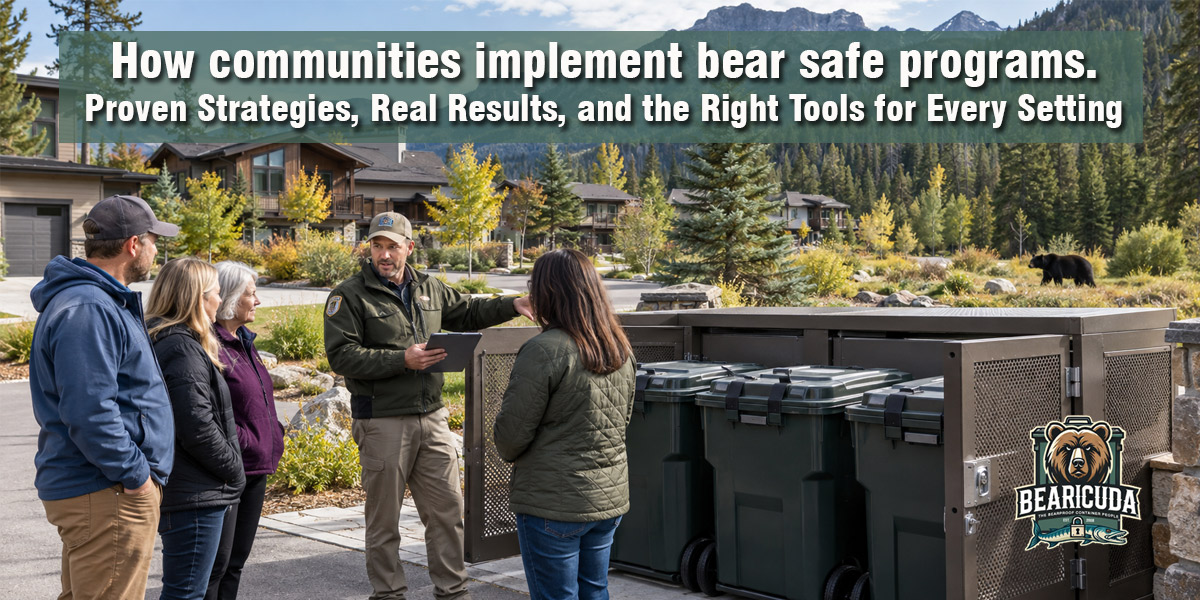
How Communities Implement Bear-Safe Programs.
Proven Strategies, Real Results, and the Right Tools for Every Setting.
Every year, thousands of black bears wander into towns and neighborhoods across North America — not because they want to live among people, but because they smell food. Unsecured garbage is the single biggest attractant drawing bears into human communities, and once a bear learns that trash cans are an easy meal, the consequences can be fatal. Bears that become food-conditioned are often relocated or euthanized. In 2020 alone, Colorado euthanized 120 bears due to human-bear conflict (Colorado State University).
But it doesn't have to be this way. Across the continent, communities are proving that bear-safe programs — combining ordinances, bear-resistant containers, public education, and enforcement — can dramatically reduce bear encounters, protect property, and save bears' lives. This article examines what those programs look like, the measurable results they've achieved, and how Bearicuda's product lineup maps to the three settings where bear-safe infrastructure matters most: residential, parks and community spaces, and business environments.
What Makes a Bear-Safe Program Work
Successful community bear-safe programs share a common architecture. Research and field experience consistently point to four pillars:
1. Securing Attractants — Especially Garbage
The scientific literature is unambiguous: eliminating access to anthropogenic food sources is the most effective way to reduce human-bear conflict. A landmark peer-reviewed study of Seminole County, Florida's Urban Bear Management Ordinance found that simply providing bear-resistant garbage cans to residents, combined with an ordinance requiring attractants to be secured, reduced human-bear interactions (HBI) by 54% — and reduced bears observed eating garbage to zero (Telesco et al., 2023, via BearWise).
2. Community-Wide Ordinances with Enforcement
Voluntary compliance alone is not enough. The Florida study noted that "education alone will not reduce HBI." Communities that pair container distribution with enforceable ordinances — requiring residents to secure garbage, bird feeders, pet food, and other attractants — see the steepest reductions in conflict (Telesco et al., 2023). Aspen, Colorado, for example, requires wildlife-resistant trash containers citywide and has issued citations and tagged hundreds of containers with warnings during peak bear season (City of Aspen).
3. The Right Containers for the Setting
Container technology matters. Studies in Durango, Colorado, from 2011 to 2016 found that manually locking trash containers helped reduce conflict, but residents often failed to latch both clips properly — allowing bears to continue accessing trash. When the city distributed fully automated, self-locking containers in 2018 and 2019, compliance improved dramatically. By 2021, 98.4% of containers in the study area were bear-resistant, and 65.5% locked automatically (Colorado State University).
4. Sustained Education and Outreach
Programs that endure are programs that educate. Whistler, British Columbia, employs a designated Bear Smart employee who conducts door-to-door outreach, public events, and presentations. The municipality also enforces waste and attractant management bylaws through regular neighborhood inspections (Resort Municipality of Whistler).
Proven Programs: Case Studies with Real Statistics
Seminole County, Florida — Urban Bear Management Ordinance
Location: Seminole County, central Florida
Program established: February 7, 2016
Key measures: Ordinance requiring residents in a 148 km² zone to secure all bear attractants within 30 days; distribution of 3,622 bear-resistant garbage cans (64-gallon Toter BearTight models) to treatment neighborhoods; FWC canvassing and education; partnership with waste hauler Waste Pro
Results (from a peer-reviewed before-and-after study):
| Metric |
Before Program |
After Program |
Change |
|
Residents reporting at least one human-bear interaction |
82% |
28% |
54% reduction |
|
Bears observed eating garbage |
42% |
0% |
Eliminated |
|
Respondents reporting property damage |
21% |
2% |
~90% relative decline |
|
Mean annual core HBI calls to FWC |
— |
— |
40% decline |
|
Mean annual garbage-related calls to FWC |
— |
— |
46% decline |
|
Bears euthanized per year (5-year comparison) |
5.8/year |
2.4/year |
59% decline |
Source: Telesco et al., 2023
The study also found that 57% of residents reported an improved quality of life after receiving bear-resistant containers, and 71% of those who reported improvement said they felt more secure because of fewer bear encounters. Notably, bears continued to live in the area — the program reduced conflict, not bear presence.
Durango, Colorado — Automated Bear-Resistant Container Program
Location: Durango, southwest Colorado
Key measures: City trash ordinance requiring bear-proofing; distribution of manually locking containers (2011–2016 study), followed by fully automated, self-locking containers (2018–2019)
Key findings:
- 98.4% of 2,048 containers in the study area were bear-resistant
- 65.5% of bear-resistant containers locked automatically (improving compliance over manual latches)
- In summer 2021, researchers recorded 151 potential conflict events; 60.3% were failed bear attempts (containers knocked over but not breached), and only 39.7% resulted in spilled trash
- The 2021 conflict rate was significantly lower than in previous years
Source: Colorado State University
The Durango experience underscores a critical lesson: container design must account for human behavior. Automated, self-locking containers solved the compliance problem that undermined earlier manual-latch programs.
Whistler, British Columbia — Bear Smart Community
Location: Whistler, BC, Canada
Bear Smart designation: Since 2011
Key measures: Bear-proofing the entire waste-management system (two compactor sites, no curbside pickup); guidelines for bear-proof enclosures for businesses and multi-unit residential complexes; non-lethal bear-management training for police and wildlife agencies; Neighbourhood Bear Watch program with hotline and door-to-door canvassing; habitat disenhancement (removing berry bushes in high-conflict areas); public education campaign
Results:
- "Problem" bears destroyed in Whistler reduced by 70%
- In 2024, only 4 of 303 black bears killed by the BC Conservation Officer Service across the province occurred in Whistler
Source: Get Bear Smart Society / GoBC, Resort Municipality of Whistler
Whistler's Bear Smart designation — a provincial standard requiring communities to meet specific criteria addressing the root causes of human-bear conflict — has become a model for other communities across British Columbia and beyond.
Yosemite National Park — Food Storage and Bear-Resistant Infrastructure
Location: Yosemite National Park, California
Key measures: Mandatory food storage regulations requiring all food, attractants, and garbage to be stored in park-approved bear-resistant containers, food lockers, bear-resistant trash cans/dumpsters, or hard-sided structures; widespread installation of bear-resistant food storage lockers at campgrounds and trailheads
Results:
- Bear incidents down 91% from the same point in 1998, the highest-incident year on record
- As of the NPS page's most recent update, 34 bear incidents were listed for the current year
Source: National Park Service — Yosemite Bear Facts
Yosemite's dramatic reduction demonstrates what's possible when bear-resistant infrastructure is deployed comprehensively across an entire landscape — from campground food lockers to bear-resistant dumpsters in parking areas.
Aspen, Colorado — Wildlife-Resistant Container Ordinance and Enforcement
Location: Aspen, Colorado
Key measures: Citywide ordinance requiring wildlife-resistant trash containers; enforcement with citations and container warning tags; city-provided bear-resistant containers available to loan; public education during peak bear activity (hyperphagia)
What the data shows:
- 388 bear trash intrusions recorded January 1 – August 19 (compared to 167 in the same period of 2025 and 91 in 2024)
- 19 citations issued and hundreds of containers tagged with warnings
- The city's tracking data demonstrates that bear intrusions correlate directly with seasonal food availability — making container compliance critical during hyperphagia
Aspen illustrates the enforcement and monitoring side of bear-safe programs. Its data shows bear intrusions rising in years when natural food is scarce, underscoring why consistent container compliance — not just having the right containers, but keeping them latched — matters most during peak bear season.
Source: City of Aspen
Implementation Playbook: How to Build a Bear-Safe Community
Based on the programs above, here's a practical framework for any community looking to reduce bear conflicts:
Step 1: Audit Attractants
Conduct a community-wide survey of garbage storage practices, bird feeder use, pet food storage, fruit trees, compost, and commercial waste areas. Identify hotspots where bears are already active.
Step 2: Pass an Ordinance
Follow the Seminole County and Aspen models: require residents and businesses in bear-active zones to secure all attractants, with penalties for noncompliance. Define bear-resistant container standards (IGBC certification or equivalent).
Step 3: Choose the Right Containers for Each Setting
Not all bear-resistant products are suited for all environments. A residential curbside cart, a park trailhead receptacle, and a commercial dumpster face very different demands. (See the Bearicuda product guide below.)
Step 4: Distribute and Install
Provide bear-resistant containers directly to residents — the Florida study showed that fewer than 5% of residents owned bear-resistant cans before distribution. Partner with waste haulers to ensure compatibility with automated collection trucks.
Step 5: Educate and Enforce
Launch a sustained public education campaign (door-to-door outreach, signage, media). Enforce ordinances consistently — the data shows that compliance, not just container availability, drives results.
Step 6: Measure and Adapt
Track bear incidents, public calls, and container compliance over time. Use multiple data sources — surveys, agency call logs, and telemetry — to evaluate effectiveness.
Bearicuda Products by Application
Bearicuda designs and manufactures a full spectrum of bear-resistant waste containment products in the United States, using U.S.-sourced materials. Select Bearicuda products are tested or certified by organizations such as the Interagency Grizzly Bear Committee (IGBC), the Living With Wildlife Foundation (LWWF), the Grizzly and Wolf Discovery Center (GWDC), and the U.S. Forest Service — the leading standards for bear-resistant product certification. Below is a guide to which products fit each setting.
Residential Applications
Homeowners need containers that are bear-resistant, compatible with curbside waste pickup, and practical for daily use. Bearicuda's residential lineup ranges from budget-friendly individual cans to heavy-duty metal enclosures for properties without garages.
| Product |
Capacity |
Key Features |
Best For |
|
Stealth 2 (Automated Curbside Can) |
65 or 95 gallons |
Fully automated — opens when hauler tips the can; bear-resistant latch assembly; compatible with automated waste trucks; attractive curbside design |
Homes with curbside pickup; one of the closest products on the market to a truly bear-resistant curbside can |
|
Titan (Metal Bear-Resistant Can) |
65 or 95 gallons |
Toughest bear-resistant can Bearicuda manufactures; optional paddle latch that auto-locks on closing; heavy-duty metal construction |
Rural properties, cabins, high bear-activity zones |
|
Basic (Screw-Top Canister) |
20 or 30 gallons |
Budget-friendly; airtight screw-top lid seals in odors; LWWF-tested; lightweight |
Smaller households, secondary containers, food storage |
|
Highlander (Metal Enclosure) |
Holds 1, 2, or 3 trash cans (up to 90 gal) |
10/12/14-gauge welded steel; Bearicuda's most popular enclosure (15+ years); fits single-family homes |
Homes without garages; properties needing secure can storage |
|
Silverback (Metal Can Storage) |
Single, double, or triple units |
Powder-coated, all-welded heavy-gauge steel; tested by LWWF and GWDC using IGBC protocol; ships fully assembled |
Residences and large communities needing certified protection |
|
Telluride (ADA-Compliant Receptacle) |
32 or 64 gallons |
Gravity paddle latch system; optional padlock; decorative panel options; sandblasted epoxy primer with TGIC polyester top coat |
Residential applications where aesthetics and ADA compliance matter |
Sources: Bearicuda — Animal-Proof Trash Cans, Bearicuda — Metal Enclosures, Bearicuda — Stealth 2, Bearicuda — Titan, Bearicuda — Highlander, Bearicuda — Silverback, Bearicuda — Telluride
Residential recommendation: For homes with curbside pickup, the Stealth 2 is the ideal choice — its fully automated design solves the compliance problem identified in Durango, where manually latched containers were often left unsecured. For properties without garages or in high bear-activity zones, the Highlander or Silverback metal enclosures provide IGBC-certified protection.
Parks and Community Spaces
Parks, campgrounds, trailheads, and public spaces need containers that are bear-resistant, user-friendly for the public, and durable enough to withstand heavy use and determined wildlife. Bearicuda offers purpose-built products for these environments.
| Product |
Capacity |
Key Features |
Best For |
|
Whistler Food Storage Lockers |
16, 30, or 46.5 cubic ft (1–6 doors) |
US Forest Service tested (4-star rating at Missoula Technology and Development Center); IGBC certified; 10/12/14-gauge steel; water-resistant; ADA-compliant options |
Campgrounds, trailheads, parks — anywhere food and personal items need protection |
|
Forester Food Storage Lockers |
11 cubic ft |
Wide-open interior for larger items; ideal for parks, campsites, playgrounds, and trailheads |
Trailhead food storage, campsites |
|
Acadia Trash Bin Enclosures |
55–150 gallons |
ADA-compliant; some models hold trash bags directly, others hold cans or recycling streams; gravity and paddle latches; heavy-duty steel |
Public parks, sidewalks, community spaces |
|
Yellowstone Chute-Style Enclosures |
40–50 gallons (single or double) |
Chute-style deposit; fits one or two 40–50 gallon cans |
Public spaces where easy, hands-free trash disposal is needed |
|
Razorback Public Enclosures |
40–95 gallons (single or double) |
LWWF-tested with grizzly bears; designed for public environments — parks, sidewalks, campgrounds; optional Bear Guard Lid |
Parks, sidewalks, campgrounds, public venues |
Sources: Bearicuda — Whistler Lockers, Bearicuda — Forester Lockers, Bearicuda — Acadia Enclosures, Bearicuda — Yellowstone, Bearicuda — Razorback Public
Parks recommendation: For campgrounds and trailheads, the Whistler Food Storage Lockers are the gold standard — US Forest Service-tested and IGBC-certified, with sizes ranging from single-door to six-door configurations. For public trash collection in parks and along sidewalks, the Acadia and Razorback enclosures provide certified bear resistance with user-friendly access.
Business and Commercial Environments
Businesses — restaurants, lodging, retail, HOAs, and municipal facilities — produce larger volumes of waste and need commercial-grade bear-resistant infrastructure. Bearicuda's dumpster and commercial enclosure lines are engineered for these high-demand settings.
| Product |
Capacity |
Key Features |
Best For |
|
Guardian Front Load Dumpsters |
2, 3, 4, 6, or 8 cubic yards |
Heavy-duty 12/14-gauge steel; front-load design; select models LWWF & IGBC certified (verify by size/configuration); optional dump bars, drain holes, sliding doors, casters, colors |
Restaurants, hotels, retail, commercial properties, HOAs |
|
Guardian Rear Load Dumpsters |
1.5, 2, 3, 4, 6, or 8 cubic yards |
Heavy-duty 10/12/14-gauge steel; rear-load design; select models LWWF certified; optional paddle latches, cable hooks, drain holes, casters |
Properties with rear-load waste collection |
|
Gatekeeper Pedestal Enclosure |
Various |
Laser-cut, bent, and welded steel; locked with heavy-duty carabiners on chain; fully bear-resistant design |
Secure commercial waste areas, restricted-access locations |
|
Razorback Large Metal Enclosures |
Up to 95-gallon cans |
LWWF-tested with grizzly bears; multi-unit configurations; heavy-duty all-welded steel |
Multi-unit residential, commercial complexes, shared waste areas |
Sources: Bearicuda — Guardian Front Load, Bearicuda — Guardian Rear Load, Bearicuda — Gatekeeper, Bearicuda — Razorback Large
Business recommendation: For restaurants, hotels, and commercial properties with high waste volume, the Guardian dumpsters (front or rear load, 2–8 cubic yards) provide IGBC-certified bear resistance with hauler-friendly design. For multi-unit residential complexes and HOAs, the Razorback large enclosures offer scalable, certified protection.
The Bottom Line
The evidence is clear: bear-safe programs work. Communities that combine enforceable ordinances with bear-resistant containers, sustained education, and the right infrastructure see dramatic, measurable reductions in human-bear conflict:
- 54% reduction in human-bear interactions in Seminole County, Florida
- Respondents reporting bears eating garbage dropped from 42% to 0% after bear-resistant cans were distributed
- 70% reduction in problem bears destroyed in Whistler, BC
- 91% reduction in bear incidents in Yosemite National Park since 1998
- 59% decline in bears euthanized annually after Florida's ordinance was enacted
The common thread is securing garbage — and that requires containers engineered to withstand the strength, intelligence, and persistence of bears. Bearicuda's product lineup, manufactured in the USA with U.S.-sourced materials and certified to IGBC and LWWF standards, provides bear-resistant solutions for every setting where people and bears share the landscape.
Whether you're a homeowner looking to protect your property, a parks manager outfitting campgrounds and trailheads, or a business owner securing commercial waste, Bearicuda has a certified solution designed for your needs.
Ready to build a bear-safe program for your community or property? Contact Bearicuda for a site assessment and product recommendations tailored to your environment.
your environment.