
North Carolina Bear Safety Guide: Homes, Parks, Businesses and HOAs
North Carolina black bears are common in the mountains and Coastal Plain, uncommon in much of the Piedmont, and occur across roughly 60 percent of the state’s land area. Bear-safety planning is especially relevant in western mountain communities and eastern coastal communities, while expanding bear range also makes proactive waste management valuable in central North Carolina.
North Carolina Bear Areas
Mountain bear country
Western North Carolina communities, including Asheville and Buncombe County, Hendersonville and Henderson County, Brevard and Transylvania County, Waynesville and Haywood County, Boone and Watauga County, and areas near Great Smoky Mountains National Park should treat unsecured garbage as a recurring bear attractant. In 2026, NCWRC reported 836 bear-interaction reports in Buncombe County from May through September, including 71 reports of bears inside homes. 1*
Coastal bear country
Eastern North Carolina’s Coastal Plain also supports substantial bear populations, particularly around large forested and swamp habitats. Communities and visitor destinations near the Alligator River National Wildlife Refuge, Pocosin Lakes National Wildlife Refuge, Croatan National Forest, and counties such as Dare, Hyde, Tyrrell, Washington, Bertie, Beaufort, Craven, and Carteret should prioritize animal-resistant waste containment.
Piedmont and expanding range
Although bears are less common in the Piedmont, the NCWRC notes that bear range has expanded toward central North Carolina. Communities in the Triad, Triangle, and other edge-of-range areas can reduce future conflicts by establishing secure-trash standards before a bear becomes food-conditioned. 2*
Bear-Safe Rules for Everyone
-
Secure garbage, recycling, food waste, and compost in a latched bear-resistant container.
-
Do not feed bears, intentionally or indirectly through accessible food or trash.
-
Remove bird feeders when bears are active and store pet food indoors.
-
Clean grills and outdoor eating areas; do not leave grease, coolers, or food scraps outdoors.
-
If a bear is nearby, stay calm, keep pets close, speak firmly, and slowly back away without running. 3*
Homeowner Bear Safety
Best practices for residences
Homeowners should use a bear-resistant cart for weekly household trash and keep it secured between collection days. Avoid leaving standard curbside carts outside overnight, especially when garbage contains food waste, diapers, pet-food packaging, or greasy materials.
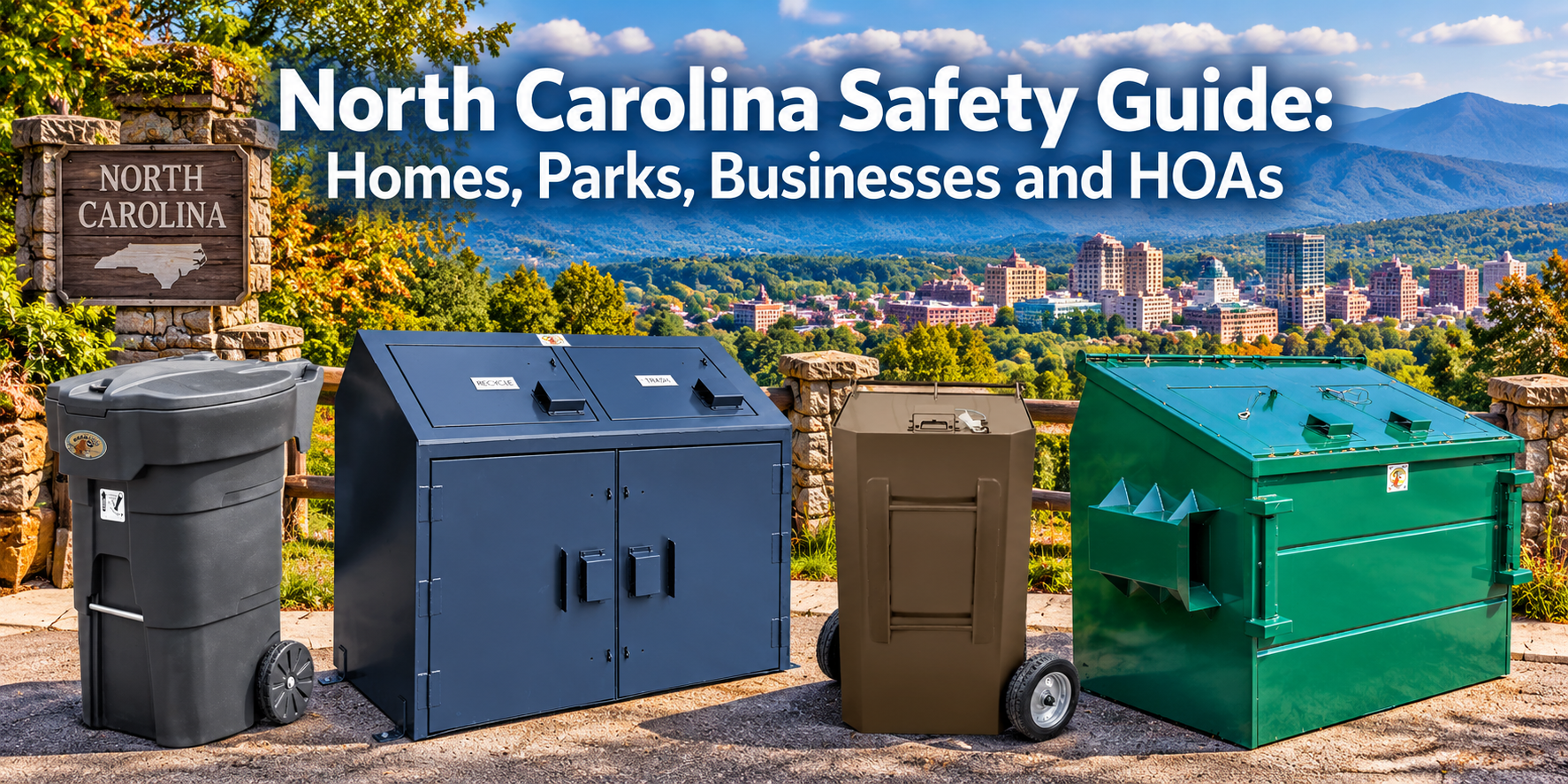
Recommended Bearicuda residential containers
-
Stealth 65- and 95-gallon fully automated bear-resistant carts are designed for compatible automated waste-hauler lift arms and use a gravity-activated locking approach that remains engaged when the cart is tipped over.
-
Titan 65-gallon metal roll-away enclosure cart is a stronger option for locations with persistent bears or animals that chew through plastic; it is steel, powder-coated, and available in 65- and 95-gallon configurations.
-
Residents should confirm cart dimensions and pickup compatibility with their local waste hauler before ordering.
Municipal Parks and Campgrounds
Protect visitors and wildlife
Parks, trailheads, recreation areas, campgrounds, and public waterfronts should keep food, litter, and overflowing bins from becoming a predictable bear food source. Install containers at picnic areas, trailheads, restroom buildings, parking lots, maintenance facilities, and campground loops; empty them before overflow and inspect latches routinely.
Recommended Bearicuda park solutions
-
Use bear-resistant metal dumpsters for high-volume waste at campgrounds, park maintenance yards, and concession areas.
-
Use metal enclosures or animal-resistant receptacles at high-traffic collection points where public access and frequent servicing are required.
-
Place clear signs at campsites and picnic areas: “Store food, coolers, scented items and trash in designated animal-resistant containers.”
Bearicuda identifies its metal dumpster systems as options for parks, campgrounds, resorts, and other settings where bears can access ordinary dumpsters.
Commercial and HOA Properties
Build a consistent waste policy
Businesses, multifamily properties, hotels, restaurants, HOAs, and resorts need a system that prevents one overflowing or unlatched dumpster from becoming a repeat bear stop. Property managers should establish a written policy covering latch checks, overflow response, trash-room cleanliness, pickup scheduling, vendor responsibilities, and resident or employee education.
Recommended Bearicuda commercial solutions
-
Guardian front-load bear-resistant metal dumpsters are offered in 2-, 3-, 4-, 6-, and 8-cubic-yard sizes for commercial, HOA, campground, and municipal waste collection.
-
Use metal enclosures for shared 65- or 95-gallon carts where a full dumpster is not needed.
-
Avoid relying on wood enclosures or standard poly dumpsters as animal-resistant solutions in bear-active areas; select a purpose-built metal, latchable system instead.
HOA implementation checklist
-
Assign responsibility for checking every lid and latch daily.
-
Keep dumpster pads free of loose bags, grease, and overflow.
-
Schedule enough collection capacity for peak occupancy and holidays.
-
Require residents to keep food waste inside until close to pickup time when feasible.
-
Post bear-safety reminders at dumpsters, mail kiosks, trail access points, and community bulletin boards.
NCWRC’s recent Buncombe County action was driven by a significant rise in bears entering dwellings, illustrating why communities should remove food rewards before bears become accustomed to visiting developed areas. 4*
Choose the Right Container
For one household
Choose a Stealth 65- or 95-gallon automated cart when compatible with the collection truck and appropriate for local bear pressure.
For repeat bear activity or chewing wildlife
Choose a Titan all-metal cart enclosure for a more durable physical barrier around a residential cart.
For shared, commercial, or public waste
Choose Guardian bear-resistant metal dumpsters sized to collection volume and waste-hauler specifications.
A bear-resistant container is most effective only when it is closed, latched, maintained, and paired with full attractant control.
Sources:
- ncwildlife temporary rule negligent bear feeding buncombe county
- ncwildlife download
- wlos bear-wise safety tips
- ncwildlife temporary rule negligent bear feeding buncombe county